


Ford F-150 vs. Super Duty: Which Pickup Is Right for Michigan Truck Buyers?
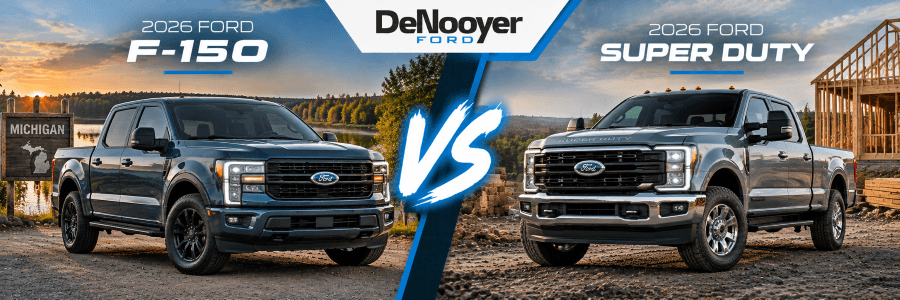
Ford F-150 vs. Super Duty: Which Pickup Is Right for Michigan Truck Buyers?
Ford offers a wide range of pickups, but one of the biggest decisions for Michigan truck shoppers is whether they need an F-150 or a Super Duty. Both offer serious capability, but they are designed for very different workloads.
How Much Truck Do You Actually Need?
For drivers around Vicksburg, Kalamazoo, and Southwest Michigan, choosing between an F-150 and Super Duty is less about which truck is bigger and more about matching the truck to the job. The F-150 combines substantial capability with everyday versatility, while Super Duty trucks are engineered for heavier trailers, larger payloads, commercial equipment, and more demanding work.
F-150 vs. Super Duty at a Glance
| Feature | 2026 Ford F-150 | 2026 Ford Super Duty |
|---|---|---|
| Truck Class | Full-size light-duty pickup | Heavy-duty pickup lineup |
| Best For | Daily driving, recreation, projects, towing, and general truck use | Heavy trailers, commercial equipment, large campers, and demanding work |
| Powertrain Variety | EcoBoost V6, 5.0L V8, available PowerBoost full hybrid V6, and other configurations | Gas V8 and Power Stroke diesel V8 options |
| Maximum Towing | Up to 13,500 lbs. when properly equipped | Higher-capacity conventional, fifth-wheel, and gooseneck configurations available |
| Maximum Available Payload | Up to 2,440 lbs. | Varies significantly by Super Duty model and configuration |
| Everyday Use | Strong balance of capability and daily drivability | Best when heavy-duty capability is regularly needed |
2026 Ford F-150: Capability for Work and Everyday Life
The 2026 Ford F-150 is designed to balance towing, hauling, passenger comfort, and everyday drivability. For many Michigan truck buyers, it provides more than enough capability without requiring the size and heavy-duty focus of a Super Duty.
The F-150 can transition from commuting and family transportation to projects, towing, and weekend recreation.
Available choices include EcoBoost V6 engines, a 5.0-liter V8, and the PowerBoost full hybrid V6.
Properly equipped 2026 F-150 configurations can tow up to 13,500 pounds.
The F-150 offers a maximum available payload of up to 2,440 pounds when properly configured.
How Capable Is the F-150?
Light-duty does not mean light on capability. Properly configured, the F-150 can handle the towing and hauling requirements of many recreational and work-focused truck owners.
LBS. Maximum Towing
Available when the F-150 is properly configured and equipped.
LBS. Maximum Available Payload
Maximum available payload depends on the truck’s specific configuration.
What Can an F-150 Handle?
For many Southwest Michigan shoppers, the F-150 sits in a useful middle ground: capable enough for serious projects and recreation while remaining practical enough to drive every day.
Properly configured F-150 models can support many recreational towing needs.
The F-150 can be a strong match for many recreational trailers when properly equipped.
Useful towing capability makes the F-150 practical for projects, equipment, and property maintenance.
Bed and payload capability can handle supplies, tools, landscaping materials, and other project needs.
Why Not Automatically Buy the Bigger Truck?
If an F-150 already meets your payload and towing requirements, moving into heavy-duty territory may provide capability you rarely use. Your actual workload should determine the truck, not simply the largest number on a specification sheet.
The F-150 balances substantial truck capability with the needs of drivers who also commute and run everyday errands.
For many shoppers, the truck also needs to work as normal transportation when there is no trailer attached.
If your trailer remains comfortably within the capability of the proper F-150 configuration, heavy-duty capacity may not be necessary.
The F-150 is designed to handle work and recreation while still functioning as an everyday full-size pickup.
2026 Ford Super Duty: When the Job Gets Bigger
The 2026 Ford Super Duty lineup is built for more demanding work. When larger trailers, heavier equipment, substantial payload requirements, or commercial duties become part of the routine, stepping up from an F-150 can make sense.
Super Duty trucks are engineered around more demanding towing, hauling, and job-site requirements.
The available 7.3-liter gas V8 provides another option for drivers who need serious heavy-duty capability.
Available 6.7-liter Power Stroke diesel V8 options provide substantial torque for demanding truck applications.
F-250, F-350, and other Super Duty configurations allow shoppers to match the truck more closely to the workload.
Super Duty Power for Demanding Work
Available Super Duty engines demonstrate how far the heavy-duty lineup moves beyond normal everyday pickup requirements.
500 HP
High-Output 6.7L Power Stroke
The available high-output diesel produces up to 500 horsepower.
1,200
LB-FT of Torque
The high-output 6.7-liter Power Stroke can produce up to 1,200 lb-ft of torque.
7.3L
Gas V8
The available 7.3-liter gas V8 produces up to 430 horsepower and 485 lb-ft of torque.
When Does Super Duty Make More Sense?
The case for a Super Duty becomes stronger as the trailer, payload, and workload become more demanding or more frequent.
Heavier recreational trailers may require capabilities beyond what an F-150 configuration can provide.
Super Duty configurations are designed for demanding equipment and professional applications.
Frequent hauling and demanding workloads can make heavy-duty capability worthwhile.
Super Duty expands your options for substantial conventional, fifth-wheel, and gooseneck towing.
Conventional, Fifth-Wheel or Gooseneck?
Your trailer type matters almost as much as its weight. Super Duty trucks offer configurations designed for multiple forms of heavy towing, while exact ratings depend heavily on how the individual truck is equipped.
Trailer ratings vary by model, engine, cab, drivetrain, axle ratio, equipment, and other factors.
Heavy-duty configurations can support fifth-wheel applications when properly equipped.
Super Duty offers configurations aimed at drivers who need substantial gooseneck trailer capability.
Start With the Trailer, Not the Truck
If towing is one of the main reasons you’re buying a pickup, determine what you need to tow before choosing the truck. Trailer weight alone does not tell the whole story.
Consider what the trailer will actually weigh when loaded for normal use.
The weight transferred to the truck affects payload and configuration requirements.
People, tools, supplies, and other cargo all contribute to the truck’s actual load.
Engine, cab, drivetrain, axle ratio, and equipment can all affect the truck’s ratings.
Payload Matters More Than Many Buyers Realize
A truck can have an impressive maximum towing number and still be the wrong configuration for your trailer if payload requirements are overlooked. Everything carried by the truck counts toward its available payload.
The portion of the trailer’s weight supported by the truck contributes to the truck’s load.
People riding in the truck add to the overall payload being carried.
Tools, equipment, supplies, coolers, and recreational gear all add weight.
Certain added equipment can also affect available carrying capacity.
Which Truck Fits Your Typical Use?
An appropriately configured F-150 may provide the capability you need without moving into heavy-duty territory.
Start with the loaded trailer specifications and determine whether an F-150 configuration comfortably meets them.
More demanding equipment and commercial applications may point toward a Super Duty configuration.
Super Duty offers configurations specifically designed for more substantial towing requirements.
F-150 or Super Duty?
Choose the F-150 If…
You want a versatile full-size truck for everyday driving, recreational towing, home projects, hauling supplies, family transportation, and job-site use without automatically moving into heavy-duty territory.
Consider Super Duty If…
Your routine involves heavier trailers, substantial payloads, commercial equipment, large campers, fifth-wheel or gooseneck towing, or demanding job-site duties that require greater heavy-duty capability.
Match Your Workload to the Right Ford Truck
| If You Prioritize… | Consider… | Why |
|---|---|---|
| Everyday Driving | F-150 | Balances substantial truck capability with everyday versatility |
| Hybrid Powertrain Option | F-150 | Available PowerBoost full hybrid V6 expands the F-150 powertrain lineup |
| Heavy Commercial Work | Super Duty | Designed for more demanding towing, hauling, and job-site applications |
| Diesel Torque | Super Duty | Available Power Stroke diesel V8 options provide substantial torque |
| Fifth-Wheel / Gooseneck Use | Super Duty | Heavy-duty configurations are available for more demanding trailer applications |
| Recreational Towing | Depends on Load | Compare the actual trailer, payload, and configuration requirements before choosing |
Questions to Answer Before Buying
Bring Your Towing Numbers With You
If towing is a major part of your purchase, bring the specifications for your trailer or equipment when you shop. Knowing loaded trailer weight, tongue or pin weight, cargo, and passenger requirements can make it easier to identify an F-150 or Super Duty configuration with the appropriate ratings.
Compare Ford Trucks in Vicksburg, MI
The right Ford truck isn’t necessarily the biggest one. It’s the truck configured appropriately for the work you need it to perform.
Visit DeNooyer Ford in Vicksburg to compare Ford F-150 and Super Duty pickups. Whether you need a versatile truck for commuting and weekend projects or a heavy-duty pickup for substantial towing and demanding work, comparing configurations can help you find the right match for your Southwest Michigan lifestyle.
Towing & Payload Information Note: Maximum towing and payload figures require specific configurations and equipment. Actual ratings vary by model, engine, cab, bed, drivetrain, axle ratio, equipment, passengers, cargo, trailer type, and other factors. Never exceed the ratings listed for the individual vehicle. Always review the truck’s specific certification labels, owner’s information, towing guidance, and applicable trailer requirements before towing or hauling.
